
In mid-November Dutch television broadcasts the official arrival of St. Nicholas and his helper Zwarte Piet live to the nation. Coming by steamer from Spain, each year they dock in the harbor of a different city or village. Wearing traditional bishop's robes, Sinterklaas rides into town on a white horse to be greeted by the mayor. A motorcade and a brass band begin a great parade which leads Sinterklaas and his Piets through the town.
Nearly every city, town and village has its own Sinterklaas parade. He usually arrives by horseback, but occaisionally he comes by boaty, carriage, moped, or helicopter.
In the following weeks before St. Nicholas Day, December 6, Sinterklaas goes about the country to determine if the children have been well-behaved. He and his Zwarte Piet helpers visit children in schools, hospitals, department stores, and even at home. Bakeries are busy making speculaas molded spice cookies for the season.
During this time children sing Sinterklaas songs and put their shoes next to the window or door, or, by the fireplace or heater, along with a nice drawing, a wish-list and a carrot or hay, and maybe a saucer of water, for the horse. If St. Nicholas happens by while checking on their behavior, the next morning children may find chocolate coins or initial letter, candy treats, pepernoten, and little gifts in their shoes. Everyone hopes for sweets, not coal or a little bag of salt. In some families he may stop by every night, but usually just once or several times—and not if the children have been naughty that day or forgot to sing their songs!
The Dutch celebrate Sinterklaas on December 5th, St. Nicholas Eve, with festive family parties when gifts and surprises are exchanged. In the Netherlands, unlike other places, adults as well as children join in the fun. As the Dutch like an element of surprise, a small gift may be wrapped in a huge box, or it may be hidden and require following clues to discover where it is.
 Child's Sinterklaas Backpack St Nicholas Center Collection |
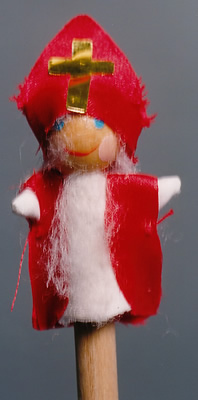 Dutch Pencil Topper St Nicholas Center Collection |
 Studies* with young children (ages 4-7) in the Netherlands show that St. Nicholas encourages positive, sharing behavior:
 One may think that traditions like the Dutch Saint Nicholas tradition makes children materialistic, greedy, and less likely to share with others as they are spoiled with gifts and candy. However, our results clearly show that children in The Netherlands still associate Saint Nicholas with "sharing with others" . . . .
Significant others, such as family members, friends, and Saint Nicholas, are pre-eminently the people that influence us and that teach us what is good, and what is bad, and what the social norms are in our society. . . . Give Dutch children a coloring picture depicting the attributes of Saint Nicholas (a book, miter, and a staff) and they will give away more of their candy.


very interesting!
ReplyDelete